7 Proven Strategies to Keep Weight Off After Stopping Ozempic

Stopping Ozempic is one of the most pivotal moments in your weight management journey — and unfortunately, one that millions of people are navigating with very little guidance. The clinical data are clear and a little sobering: most people who stop taking semaglutide regain a significant portion of the weight they lost within 12–18 months.
But “most people” doesn’t have to mean you.
The weight regain that follows stopping Ozempic isn’t inevitable. It’s predictable — and predictable problems have solutions. If you understand why regain happens and apply the right strategies during and after your transition off the medication, you can protect the progress you’ve worked hard to achieve.
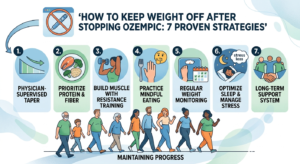
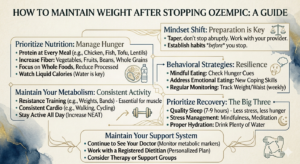
Here are seven evidence-informed strategies to help you maintain your weight after stopping Ozempic.
Why Weight Regain Happens After Stopping Ozempic
Before diving into strategies, it’s worth understanding the biology behind post-Ozempic weight regain. This isn’t about willpower or failure. It’s about physiology.
Ozempic works by mimicking the GLP-1 hormone, which suppresses appetite, slows gastric emptying, and helps regulate blood sugar. While you’re on the medication, your hunger signals are chemically modulated — many users describe simply not feeling interested in food the way they once did. Cravings quiet down. Portion control becomes almost automatic.
When you stop the medication, those appetite-suppressing effects fade — usually within days to weeks. GLP-1 levels return to baseline. Gastric emptying speeds back up. And here’s the critical part: your body’s “set point” — the weight your brain actively tries to maintain through hunger, metabolism, and energy expenditure — may still be anchored closer to your pre-medication weight.
A landmark 2022 study published in Diabetes, Obesity and Metabolism found that participants who discontinued semaglutide regained about two-thirds of their lost weight within one year, and that their metabolic markers largely reverted to baseline levels as well.


This isn’t a character flaw. It’s your body doing exactly what it’s designed to do: fight to restore a previously established energy balance.
The strategies below work with this biology, rather than against it.
Strategy 1: Start Planning Your Exit Before You Stop
The biggest mistake people make with Ozempic discontinuation is treating it as a sudden event rather than a planned transition. If you stop the medication without having built the habits, routines, and support systems to carry you forward, you’re setting yourself up for a difficult road.
Ideally, you should begin planning your post-Ozempic lifestyle at least 3–6 months before you intend to stop. This means:
Using your time on Ozempic intentionally. The suppressed appetite phase isn’t just about losing weight — it’s a window of opportunity to rewire your relationship with food, build consistent exercise habits, and establish patterns that can persist without pharmacological support.
Working with a registered dietitian. If you haven’t already, the period before and during discontinuation is the right time to work with a dietitian who can help you design a sustainable eating pattern that isn’t dependent on reduced appetite.
Tapering rather than stopping abruptly. If your doctor agrees, a gradual dose reduction gives your appetite systems time to adjust more slowly rather than rebounding all at once.
Strategy 2: Build Your Protein Foundation
Of all the dietary variables that predict long-term weight maintenance, protein intake is the most consistently supported by research.
Protein helps with weight maintenance through several mechanisms:
- It has the highest thermic effect of any macronutrient (your body burns more calories digesting it)
- It promotes satiety more effectively than carbohydrates or fat
- It preserves lean muscle mass, which is metabolically active and burns more calories at rest
- It reduces the cravings for highly palatable, processed foods
The challenge after stopping Ozempic is that your appetite returns — and for many people, it returns with a vengeance, accompanied by cravings for precisely the kinds of foods that contributed to weight gain originally.
A high-protein diet provides a natural buffer. When you’re consistently consuming 100–130 grams of protein daily (or approximately 1.2–1.6g per kilogram of body weight), you’ll feel fuller throughout the day, experience fewer intense cravings, and preserve the muscle you may have built during your weight-loss phase.
Practical protein targets by meal:
- Breakfast: 25–35 grams (eggs, Greek yogurt, cottage cheese, protein shake)
- Lunch: 30–40 grams (lean meats, legumes, fish, tempeh)
- Dinner: 30–40 grams (chicken, turkey, salmon, lentils)
- Snacks: 10–15 grams (string cheese, edamame, hard-boiled eggs)
Strategy 3: Make Resistance Training Non-Negotiable
Weight loss of any kind — whether from medication, diet, or bariatric surgery — almost always includes some loss of lean muscle mass alongside fat loss. This matters enormously for long-term weight maintenance because muscle tissue is metabolically expensive: it burns calories even at rest.
When you lose muscle during rapid weight loss, your resting metabolic rate (the number of calories your body burns just to stay alive) decreases. This means your body now needs fewer calories to maintain its new weight — which is one of the reasons maintaining weight loss is harder than achieving it in the first place.
Resistance training is the most effective way to rebuild and preserve muscle mass, and it should be a cornerstone of your post-Ozempic maintenance plan.
What the research recommends:
- 2–4 sessions of resistance training per week
- Focus on compound movements (squats, deadlifts, presses, rows) that engage large muscle groups
- Progressive overload — gradually increasing weight or resistance over time
You don’t need a gym membership or sophisticated equipment to get started. Bodyweight training, resistance bands, and dumbbells are all effective. The key is consistency over intensity, especially in the first few months after stopping Ozempic when hunger may be returning and motivation can fluctuate.
Beyond muscle preservation, exercise also affects the very hormones that drive hunger and satiety. Regular physical activity improves insulin sensitivity, reduces fasting insulin levels, and helps regulate ghrelin (the primary hunger hormone) — all of which create a more favorable hormonal environment for weight maintenance.
Strategy 4: Retrain Your Hunger Cues
One of the underappreciated gifts of being on Ozempic is that it gives many people their first real experience of natural hunger and fullness — eating when genuinely hungry, stopping when satisfied, and not being controlled by food noise.
When you stop the medication, this clarity fades. Hunger returns. The challenge is learning to navigate that hunger without reverting to old patterns.
Mindful eating practices — which have a solid evidence base in weight management literature — become especially valuable here:
- Eating slowly and without distractions: It takes about 20 minutes for satiety hormones to communicate fullness to your brain. Eating quickly bypasses this mechanism.
- Using a hunger scale: Before reaching for food, pause and rate your hunger from 1 (starving) to 10 (uncomfortably full). Aim to eat at 3–4 and stop at 6–7.
- Front-loading vegetables and protein: Starting meals with fiber-rich vegetables and a protein source before carbohydrates naturally slows eating pace and promotes earlier satiety.
- Sitting down for meals: Eating while standing, driving, or multitasking is consistently associated with greater caloric intake.
These practices require deliberate attention at first, but with repetition, they become more automatic — essentially building the conscious version of what Ozempic did pharmacologically.
Strategy 5: Monitor Your Weight Consistently (But Not Obsessively)
Research on long-term weight maintenance consistently shows that regular self-monitoring is one of the strongest predictors of success. Participants in the National Weight Control Registry — a database of people who’ve maintained significant weight loss long-term — overwhelmingly report weighing themselves frequently as a key strategy.
The goal isn’t perfection. Your weight will naturally fluctuate by 1–4 pounds daily based on hydration, sodium intake, hormonal cycles, and digestive timing. These fluctuations are normal and don’t represent fat gain.
What you’re watching for is a sustained upward trend over 2–4 weeks that indicates true weight regain rather than normal variation.
A sustainable monitoring approach:
- Weigh yourself 3–5 times per week, at the same time each morning (after using the bathroom, before eating)
- Record your weight in a simple app (Happy Scale, Libra) that shows a trend line rather than individual daily numbers
- Set a “ceiling weight” — typically 5–7 pounds above your maintenance goal — that triggers a review of your habits if you reach it
- Don’t use the scale as a measure of your worth or progress on any given day — it’s simply a data point
Strategy 6: Build a Sustainable Eating Pattern, Not a Diet
The word “diet” implies a beginning and an end. Long-term weight maintenance requires a sustainable eating pattern that you can live with indefinitely — not a temporary restriction that you abandon once you’ve hit your goal.
People who successfully maintain weight loss long-term tend to share certain eating characteristics:
- They eat mostly whole, minimally processed foods — not because they’re following a rigid plan, but because they’ve restructured their default food environment to make these choices easier.
- They’ve reduced (not necessarily eliminated) ultra-processed foods. Ultra-processed foods are engineered to override your satiety signals. When your appetite is no longer pharmacologically dampened, these foods can trigger overconsumption more easily.
- They cook at home most of the time. Home-cooked meals average significantly fewer calories than restaurant meals, even when you’re trying to eat healthily out.
- They have strategies for social eating. Parties, dinners out, holidays — these are fixtures of life, not emergencies. Having a plan (eat a protein-rich snack beforehand, choose one splurge item, drink water between alcoholic drinks) makes these events manageable without derailing maintenance.
The Mediterranean eating pattern, the DASH approach, and general balanced eating frameworks all share the same core principles: lots of vegetables, adequate protein, healthy fats, limited sugar and refined carbohydrates. None of them require calorie counting — though tracking calories for a few weeks after stopping Ozempic can be educational if you’ve never done it before.
Strategy 7: Address the Psychological Drivers of Weight
This is the strategy most frequently overlooked and most often responsible for weight regain — not just after Ozempic, but after any weight-loss intervention.
For many people, food serves functions beyond nutrition: it’s comfort, celebration, stress relief, boredom management, and emotional regulation. Ozempic doesn’t address these functions — it simply suppresses appetite enough that they become less compelling in the short term. When the medication stops, these patterns can return intact.
Long-term weight maintenance research consistently identifies psychological and behavioral factors as primary predictors of outcomes. People who maintain their weight successfully tend to have:
- A stable, positive relationship with their body (not perfectionistic or punishing)
- Effective non-food coping strategies for stress and difficult emotions
- Social support from people who reinforce healthy behaviors
- A sense of intrinsic motivation for health rather than purely appearance-based goals
This is where working with a therapist or psychologist trained in behavioral medicine or eating behavior can be genuinely transformative — not because there’s anything wrong with you psychologically, but because the behavioral aspects of weight management are genuinely complex and deserve the same professional attention as the physiological ones.
Cognitive behavioral therapy (CBT) adapted for weight management has the strongest evidence base among psychological interventions. But even regular support groups, online communities of people in similar situations, and accountability relationships with friends or coaches can provide meaningful support.
A Note on Returning to Ozempic
It’s worth addressing directly: some people who stop Ozempic and regain weight will need to restart the medication. This isn’t a failure. Obesity is a chronic condition with strong biological drivers, and for many people, long-term or intermittent pharmacological support is a legitimate medical tool — just as someone with hypothyroidism takes thyroid medication indefinitely.
If you’ve made genuine lifestyle changes and are still struggling with significant weight regain after stopping Ozempic, speak with your doctor about whether restarting makes sense for your health. The goal is always your long-term well-being — not proving that you can manage without medication.
What the First 90 Days After Stopping Look Like
Weeks 1–2: Appetite begins returning. You may feel hungry more often than you did on the medication. This is normal. Lean on protein-rich foods and mindful eating practices to buffer the increased hunger.
Weeks 3–6: Hunger is fully back. This is typically the highest-risk window for reverting to old habits. Double down on all seven strategies above. This period will define your trajectory.
Months 2–3: Habits either start to solidify or cracks appear. If you’re seeing the scale creep significantly, now is the time to adjust — not after another 20 pounds.
Months 3–6: Most people who make it to this point with stable weight are in a reasonable position for longer-term maintenance. Your hunger hormones are stabilizing, your habits are more automatic, and your relationship with food should be clearer.
Frequently Asked Questions
How much weight will I regain after stopping Ozempic?
Clinical data suggest that without lifestyle intervention, most people regain 50–70% of lost weight within one year. However, people who implement robust behavioral strategies, including regular exercise and dietary changes, can significantly limit regain.
How long does it take for appetite to return after stopping Ozempic?
Semaglutide has a half-life of about one week. Most people notice their appetite returning within 1–2 weeks of stopping, though the full return to baseline appetite typically takes 4–8 weeks.
Can I ever eat “normally” again after Ozempic?
Yes — but “normal” may need to be redefined. The goal is to establish eating patterns that are enjoyable, sustainable, and health-supporting, rather than returning to the habits that contributed to the original weight gain.
Is it okay to take Ozempic long-term?
For many people with obesity or type 2 diabetes, long-term use is both safe and appropriate. This is a conversation to have with your doctor based on your individual health situation.
What’s the biggest mistake people make after stopping Ozempic?
Assuming they can maintain the same eating habits without the medication’s appetite suppression. The second biggest mistake is not building resistance training habits while on the medication.
The Bottom Line
Stopping Ozempic is not a sentence to regain all the weight you lost. But it does require intentional, sustained effort in areas that many people underestimate — particularly protein intake, resistance training, and the psychological aspects of eating behavior.
The seven strategies in this article aren’t hacks or shortcuts. They’re the same principles that long-term weight maintainers — with or without medication — have used successfully. Applied consistently, they give you the best possible foundation for protecting the health gains you’ve worked hard to achieve.
The transition off Ozempic is one of the most critical windows in your weight management journey. Treat it that way, and you’ll be in a far stronger position than most.
This article is for informational purposes only and does not constitute medical advice. Always consult your healthcare provider before making changes to your medication or treatment plan.